
Elliot Koubis
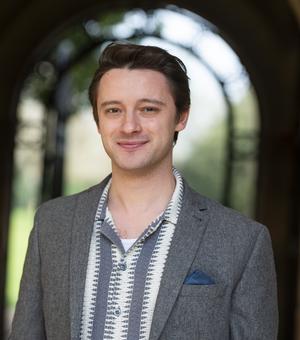
I am a DPhil candidate in French and Modern Greek at the University of Oxford, and I tutor French Cinema at St John’s College. My doctoral research is funded by an Open-Oxford-Cambridge AHRC DTP studentship and a Clarendon Fund Scholarship. My supervisors are Professor Dimitris Papanikolaou and Professor Andrew Counter. I read French and Modern Greek Literature for my BA at St Peter’s College, Oxford, before completing an MSt in Modern Greek at Worcester College with an Onassis Scholarship.
My thesis examines the Greek reception of Édouard Louis, a French writer whose work explores his upbringing as a gay working-class man and his family’s struggles with the circumstances of their class. Louis’s link to Greece is strong. He enjoys a wide readership in the country, and more of his works have been published in Greek translation than in English. What is more, Greek theatres have staged six of his works, sometimes with Louis playing himself, whereas the UK and the US have staged three works each. Through these productions, his public appearances and his residence in Greece for part of the year, Greek journalists often treat him as a local presence. They also adapt his work to their own political purposes, especially around self-reinvention, poverty and austerity, the rise of the far right, the Left’s relation to the working class and the role of the mother within the family.
What does Louis’s reception in Greece reveal about how forms of queer or elective affinity, LGBTQ+ identity, self-making and survival cross borders? How do Greek readers translate, contest and reshape them? I address these questions by tracing how Louis’s writing moves between, and challenges, different models of kinship in France and Greece. I also show why these frameworks become particularly charged in Greece, where family bonds can feel non-negotiable, especially for LGBTQ+ subjects. I argue that Louis has become a significant figure in contemporary Greek culture not only because his work is widely translated and staged there, but because Greek critics and writers use him to think through local questions about kinship, vulnerability and precarity in the aftermath of the Greek financial crisis.
Using queer theory and reception theory, I read Greek press coverage and cultural commentary alongside literary and theoretical texts. I compare Louis with contemporary Greek writers including the lesbian activist and photographer Maria Cyber, the poet and academic Spyros Chairetis, and the life-writer sam albatros. In addition, I compare the Greek reception of him as a political and theoretical figure to Greek queer activists’ responses to the murder of activist and drag performer Zak Kostopoulos in 2018, a turning point in Greek queer politics. This comparative frame helps me test the limits of ‘queer’ as a critical category and to foreground culturally specific ways of describing sexuality and affinity. Across the thesis, I trace how biological family, chosen kinship and class shame intersect. This includes looking at how life-writing can both rupture familial ties and attempt forms of repair, and how it can therefore test ways of thinking about queer kinship in Greece and France.
Alongside my doctoral work, my broader research interests include Constantine Cavafy, translation theory and queer necropolitics. I have translated work by Guillaume Apollinaire (with Iris Colomb) and Henri Barbusse for Ampersand Publishing (2017). I published a review of the English translation of Louis’s Changer: méthode in French Studies, and I have an article under peer review with the Australian Journal of French Studies on Louis and Spyros Chairetis. I am a member of the ‘Greek Studies Now’ research group and I co-convene ‘Queer Intersections Oxford’. I have presented at conferences in the UK and abroad, and I have completed research projects for the Victoria and Albert Museum (2025–26), the Europaeum (2024) and the National Trust (2023).

